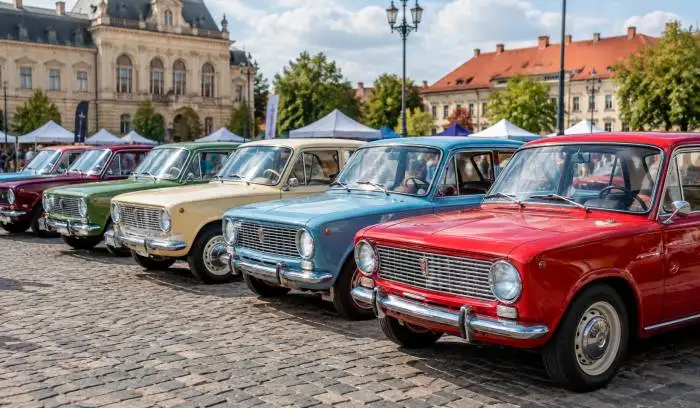
Among the Interesting Eastern European Cars, the Zastava 600 holds an important place in automotive history. Zastava's co-operation with Fiat began with the production of its 1400 in 1954. The 1400 was somewhat large and expensive for its intended Yugoslav market, so the company soon chose the cheaper end of the scale and secured a license to build the then-new Fiat 600 in its home market.
Initially assembled with parts imported from Italy, Zastava soon manufactured the model completely in-house to meet the growing local demand for simple, affordable transport. The 600 underwent several updates under Zastava's management, although none were as drastic as the four-door version produced by Seat in Spain.
The final version used an 848cc four-cylinder engine producing 32hp, sufficient to accelerate from zero to 62mph in 29.4 seconds. This was a major improvement over the original's 21.5hp engine, which took over a minute to reach 62mph and could not go faster.
Classic Eastern European Cars That Shaped Automotive History
Classic Eastern European cars reflect a unique era of automotive design, engineering, and everyday transportation. From the Trabant and Tatra to the Škoda and Dacia, these memorable vehicles left a lasting mark on car history.
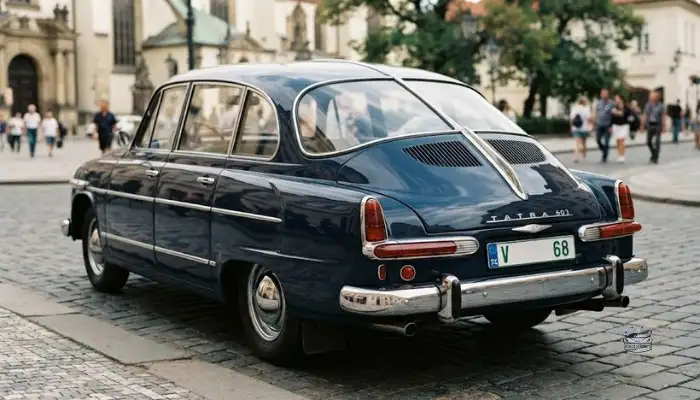
Tatra 603 (1956)
The Tatras themselves carved a unique slot in automotive design history. The T603 that emerged in 1956 was only the most recent development in a line of conceptually progressive vehicles boasting a shell which is arguably still at a leading edge in aerodynamic terms, and an air-cooled V8 engine which is positioned ahead of the rear axle.
The Tatras that plied the streets of Eastern Europe were the sorts of vehicles you definitely didn't want showing up outside your home early one morning as they were mainly the state vehicles of people at the top, from the Kremlin all the way across through the eastern bloc. Some made it out of the eastern bloc, even. Many believe Fidel Castro to be the owner of one of white T603's, which had been retrofitted with a refrigerator air conditioning unit.
Read More: Geely EX5 2025 Review: The Budget-Friendly Electric SUV
Skoda 1000 MB (1964)
As the developing process of the 1000 MB was being entered by Skoda, the design was being focused on by their western neighbours and inspiration with the engine placed in the rear; this was very common among some of the best-selling cars in western Europe (e.g. The Fiat 600, Volkswagen Beetle or Renault Although some prototypes with the engine in the front were created by them (either with front or rear wheel drive), the same solution with a rear-mounted engine has ultimately been decided to be used by Skoda as it was most popular in Europe.
Front wheel drive has been deemed too bold by them, and rear wheel drive (being too similar to the old Octavia model) has been deemed unusable.
Trabant 601 (1964)
In 1964, the Trabant 600 transitioned to the 601, which became a low-brow transport option for everyday factory workers. The Trabant 601 retained its predecessor's in-house 2-stroke 2-cylinder engine and Duroplast chassis. Aesthetically, the 601 resembled a miniature Peugeot 404 after a wash cycle at an accelerated setting.
Plans to replace this model in the early '70s fell through, so the Trabant 601 continued relatively unchanged until 1990. After Germany reunified in '89, drivers abandoned the humble Trabant as they chose new German imports, leading to thousands of 601s discarded throughout Eastern Germany, which could not be disposed of easily due to their plastic composition. One startup proposed the "eating" Trabant, which dissolved plastic for fuel production.
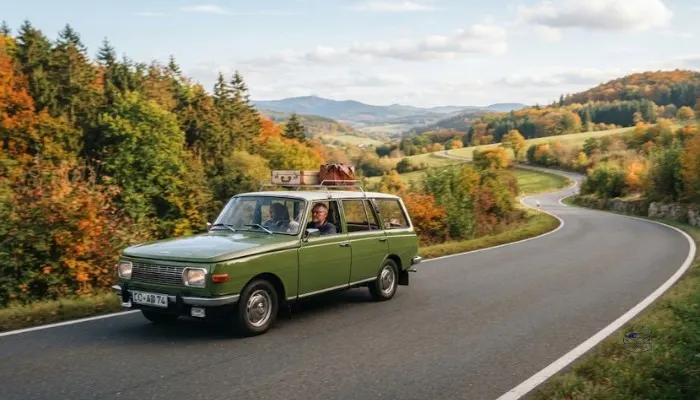
Wartburg 353 (1966)
With regard to design, the Wartburg 353 marked a considerable step forward from the 312. Designers sharply angled body styles and followed with a style that fitted in well with the emerging design cues in the latter half of the 1960s, although engineers employed a much older unit under the skin to hold down costs: a smoke producing 1.0 litre, two-stroke, 45 hp, three-cylinder engine.
This somewhat hindered its ability to find buyers in western Europe, but Wartburg at least exported 20,000 plus right-hand drive versions between 1968 and 1976. The saloon sold well to taxis in the Benelux countries, and Wartburg even sold a few 353's in West Germany. Other body styles appeared (estate and pick-up).
During its production life, visual upgrades occurred, but that outdated engine nearly outlived the Berlin Wall, with Wartburg not stopping production of the two-stroke version until 1989.
You May Also Read: 2026 Jeep Cherokee First Look: What to Expect from the
Dacia 1300 (1969)
Back in the 60s, the Romanian government wanted to find a western-designed car to produce in Romania and came to find the 12 the most suitable one even if other offers came from Alfa Romeo, Fiat, Austin, and others. The first built cars had to make use of French parts the French way and weren't all that different from the 12.
But not long after, they used Romanian parts. First on the factory 1300 from complete construction, Dacia transformed over time into a full range of vehicles ranging from 2 and 4 door pickup trucks, two types of coup. By 2004 it had produced the last model, car 12 derived which was by then succeeded by the original Logan.
Back in time, Romania produced it while 12 evolved, a journey all topped up by Renault's purchase in 1999, now with its low-cost brand among the most sold in the Old Continent even. For instance, a year ago, in 2024, Dacia Sandero topped the charts of cars sold across the 27 European Union countries, accounting for 274,202 cars.
FAQs
1. What are some interesting Eastern European cars?
Some memorable examples include the Zastava 600, Tatra 603, Skoda 1000 MB, Trabant 601, Wartburg 353 and Dacia 1300.
2. Why were Eastern European cars often simple in design?
Many were built to provide affordable and practical transportation while keeping manufacturing and maintenance costs low.
3. What made the Tatra 603 unusual?
The Tatra 603 featured an aerodynamic body and an air-cooled V8 engine positioned toward the rear, giving it a distinctive design.
4. Why is the Trabant 601 famous?
The Trabant 601 became one of the best-known cars in East Germany and was widely used as affordable everyday transportation.
5. Is the Dacia 1300 still important in car history?
Yes. The Dacia 1300 became an important Romanian car and formed the basis for a wider range of models before Dacia's later development under Renault.