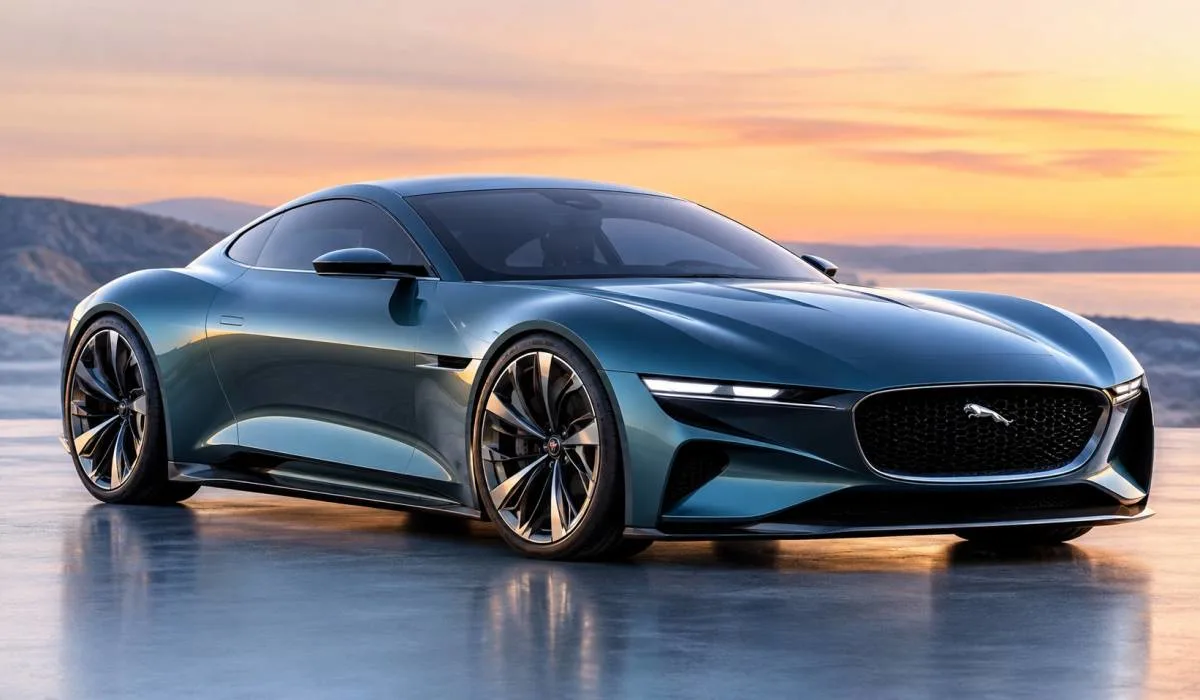
Jaguar's electric future is not a concept anymore. The Type 01 is here. It is the first production model built on a completely new electric platform and the battery technology underneath is the real story. This is not just a bigger battery. It is a new way of thinking about energy, heat, and space.
Jaguar has taken lessons from its Formula E racing team and put them into a road car. The result is a vehicle that charges fast, goes far, and manages heat in ways that most EVs do not. This guide breaks down the Jaguar electric car battery technology in plain terms. No jargon Just what it does and why it matters. Read on and understand what is under the skin of Jaguar's new EV.
The Core Specs: What You Get
The Type 01 runs on an 850-volt electrical architecture. That is high. Most mainstream EVs use 400-volt systems. Higher voltage means faster charging and less heat .
The battery itself is a 118 kWh usable nickel-manganese-cobalt (NMC) pack. Total capacity is around 120 kWh .
| Specification | Jaguar Type 01 |
|---|---|
| Architecture | 850V |
| Battery Capacity | 118 kWh usable |
| Range (WLTP) | Up to 720 km |
| Range (EPA) | Up to 400 miles |
| Max DC Charging | 350 kW |
| 10-80% Charge Time | 22 minutes |
| Range Added in 13 min | 321 km (200 miles) |
Those numbers put it in the same conversation as the Porsche Taycan and the Audi e-tron GT. It is a grand tourer, not a city car. The range is built for long distances .
Read More: Jaguar Electric Cars Tax Credit Eligible: Full 2026 Guide
The Clever Part: How the Battery Sits in the Car
This is where Jaguar did something unusual.
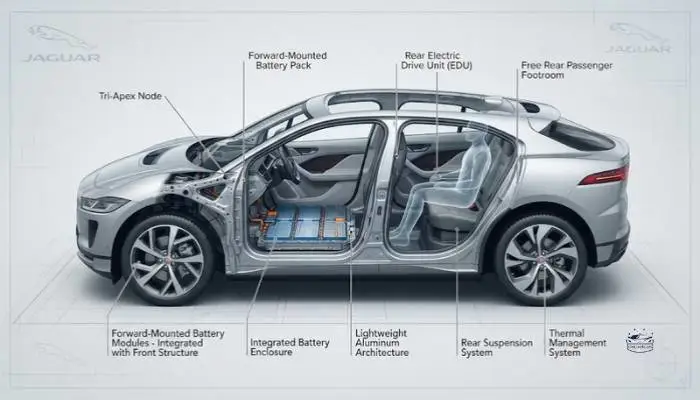
- The Type 01 is very low. It is just 1.4 meters tall. That creates a problem. You need space for battery cells to get range and power. But you also need space for people. Normally, EV batteries sit under the floor. In a low car, that eats into rear passenger footroom.
- Jaguar's solution is a piece of engineering called the Tri-Apex Node. It is a large aluminum die-casting that sits in the front of the car. It allows battery cells to be placed ahead of the passenger cabin, behind the front wheels .
- The batteries that would normally sit under the rear seats are moved forward. That space is given back to passengers. The result is a low car that still has room for people in the back. Jaguar says nobody else in the industry is doing this .
The pack is split into five separate modules. This split design helps with packaging and serviceability .
Charging: Fast, and It Can Adapt
The 850-volt system supports 350 kW DC fast charging. In 13 minutes, it can add 321 km of range. A 10-80% charge takes 22 minutes .
But there is another trick. The battery can reconfigure internally to accept a lower voltage. It can switch to 400 volts without needing a heavy external transformer. In that mode, it charges at up to 250 kW . This means you are not stranded if you find a charger that is not 800-volt capable. The car adapts.
Heat Management: Learning from Racing
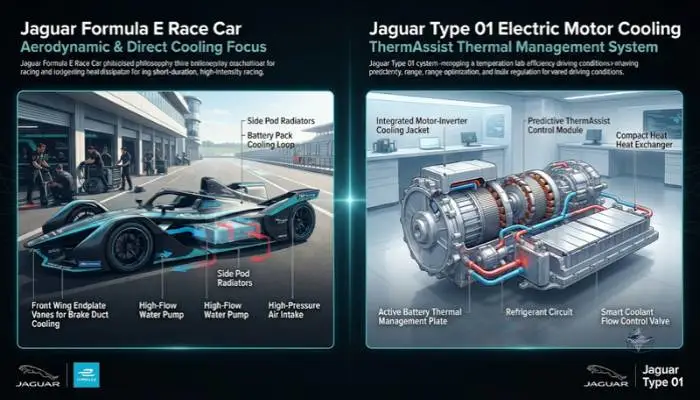
Battery performance depends on temperature. Too hot, and you lose power. Too cold, and charging slows down. Jaguar's Formula E team knows this better than most.
The Type 01 uses several heat management tricks borrowed from racing.
- Oil-submerged stator windings. The electric motors have their end windings submerged in oil. This extracts heat faster than traditional oil spray. It keeps the motors cooler and allows them to work harder for longer .
- Magnet segmentation. The magnets in the rotor are segmented. This breaks up eddy current losses. Less loss means more efficiency and less heat .
- ThermAssist. This system moves heat around the car intelligently. On a cold day, it can warm the motor before warming the cabin. It can leave the battery cold and let the motor heat up, then shed that excess heat around the car. This saves range because you are not using battery power to generate heat .
- Inverter deactivation. At highway cruising speeds, the car can switch off the rear motors entirely. It becomes a single-axle drive, using only the front motor. Jaguar says this saves about 18 miles of range on a typical drive cycle . When you need power, the rear motors come back online almost instantly.
What This Means for You?
The Jaguar electric car battery technology is not just about raw numbers. It is about solving real problems.
- You charge faster on road trips. The 350 kW charging and the 13-minute range boost make long journeys practical.
- You get consistent performance. The heat management means the car does not throttle back as quickly when you push it. The motors stay cool. The battery stays in its happy zone.
- You get space. The Tri-Apex Node means the low roofline does not come at the cost of rear passenger comfort.
- You get efficiency. The racing-derived motor and inverter tech squeezes more miles out of every kilowatt.
You May Also Read: Jaguar XF Sedan Tech Features Explained
Price and Availability
The Type 01 starts at £130,000 in the UK and $130,500 in the US . Orders open in early 2027. Deliveries begin in the second half of 2027 .
It will be built in the UK. Battery packs and electric drive units come from JLR's Wolverhampton plant. Body panels come from Halewood .For India, expect a launch around late 2027 or early 2028. The price is expected to be around Rs 2 crore .
FAQs
1. What battery does the Jaguar electric car use?
The Type 01 uses a 118 kWh usable NMC (nickel-manganese-cobalt) battery pack. It runs on an 850-volt architecture .
2. How fast does the Jaguar electric car charge?
With a 350 kW DC rapid charger, it can add 321 km (200 miles) of range in 13 minutes. A 10-80% charge takes 22 minutes .
3. What is the range of the Jaguar Type 01?
Up to 720 km on the WLTP cycle. Up to 400 miles on the EPA cycle. At sustained highway speeds, Jaguar claims up to 320 miles .
4. What is the Tri-Apex Node?
It is a large aluminum die-casting that lets Jaguar place battery cells ahead of the passenger cabin. This frees up space for rear passengers in the low-roofed Type 01 .
5. How much does the Jaguar electric car cost?
From £130,000 in the UK and $130,500 in the US. Orders open in early 2027 .
6. When will the Jaguar Type 01 be available?
Orders open in early 2027. First deliveries are expected in the second half of 2027. India launch is expected around late 2027 or early 2028 .
7. What is the horsepower of the Jaguar Type 01?
Up to 1,030 PS (757 kW) and 1,365 Nm of torque. It uses a tri-motor setup: two 310 kW motors at the rear and one 260 kW motor at the front .
8. Does the Jaguar Type 01 use Formula E technology?
Yes. The heat management, inverter deactivation, and motor efficiency work all draw on lessons from Jaguar TCS Racing's Formula E programme .